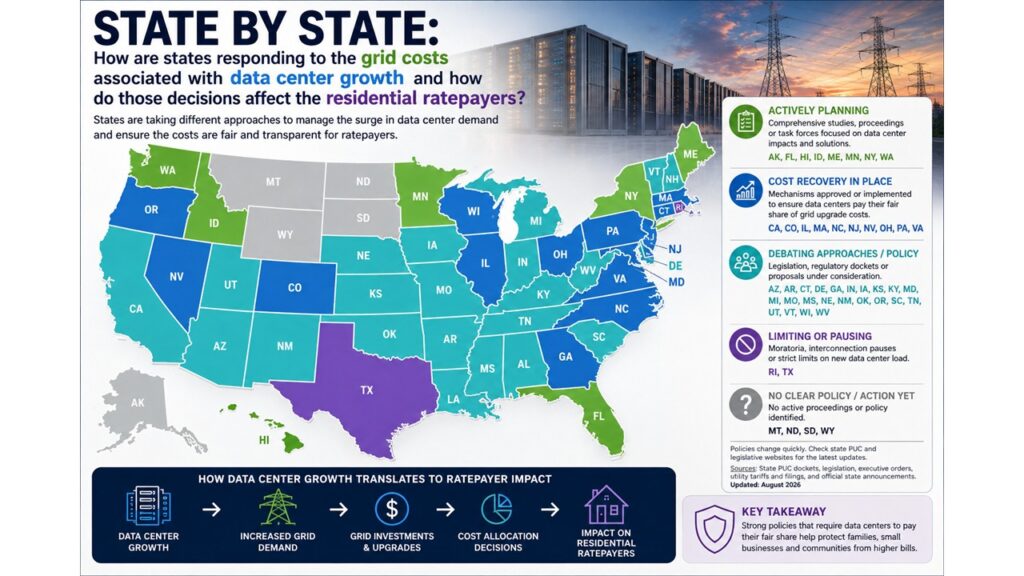
STATE BY STATE: How are states responding to the grid costs associated with data center growth and how do those decisions affect the residential ratepayers?
Affordability has moved from a background concern to a central policy question. As large new electric loads, especially data centers supporting cloud computing and artificial intelligence, seek grid connection, the state regulators are increasingly asking who should pay for the generation, transmission, and distribution upgrades required to serve these electric loads.
The pace of action by the states has accelerated. Earlier this year, roughly two dozen states had introduced or enacted measures aimed at requiring data centers to cover more of their electric service and grid expansion costs. But by mid-2026, we have more than 30 states considering data center-related legislation. The major themes of their focus are energy cost allocation, water use, siting, tax incentives, and transparency.
The state responses generally fall into one or more of the following three categories;
- Specialized tariffs or rate classes for large-load customers
- Tax and incentive changes tied to grid accountability
- Moratoriums or studies intended to slow development until cost-allocation questions are resolved.
The following examples illustrate how quickly the policy landscape is shifting:
Ohio: The Public Utilities Commission has advanced a large-load tariff model intended to ensure that major technology and data center customers pay for grid upgrades associated with their service needs.
Texas: Policymakers and grid operators are moving toward more coordinated planning for large-load interconnections, with increased attention to ensure that data centers fund the infrastructure required to serve them. Most recently, Texas Governor Greg Abbott ordered a temporary freeze on new data center connections to the state’s power grid pending a comprehensive audit by the Public Utility Commission of Texas (PUCT) and the Electric Reliability Council of Texas (ERCOT)
Virginia: As one of the nation’s largest data center markets, Virginia continues to consider policies focused on cost allocation, transparency, energy supply, and operational flexibility for hyperscale facilities.
Oklahoma: Lawmakers have pursued ratepayer protection measures designed to prevent residential customers from absorbing infrastructure costs created by large-load users.
Illinois: Legislators have examined whether data center tax incentives should be paused, narrowed, or tied more directly to energy, water, and ratepayer-protection requirements.
New Jersey: Regulators have considered frameworks that would require large-load customers to secure energy supply and contribute directly to grid upgrades rather than shifting those costs across the broader customer base.
California and Utah: State-level actions are increasingly connecting data center development approvals or benefits to those companies that demonstrate energy responsibility and infrastructure cost coverage.
Florida and Alabama: Recent proposals and enacted measures have established specialized cost-allocation frameworks, including Public Service Commission review and contract-based approaches for very large electric loads.
South Carolina, Maryland, and Tennessee: Public power negotiation rules and utility ratemaking processes are being used to assign data center-related infrastructure costs more directly to the customers creating the demand.
Arizona and Washington: Tax exemptions and other state benefits are increasingly being revisited or conditioned on clearer evidence of grid accountability.
North Carolina and Louisiana: Policymakers are weighing whether utility or tax benefits should continue unless operators cover incremental electric demand and related infrastructure costs.
New York: Some proposals have focused on pausing very large data center development until grid impacts, reliability risks, and cost-allocation standards are better defined.
Maine: Policymakers have explored pauses and study requirements to better understand how future data center development could affect utility planning and customer costs.
Minnesota: Legislative and regulatory attention has centered on studying large-load grid impacts before approving additional development at scale.
Pennsylvania, South Dakota, and Georgia: These states remain active areas for debate over large-load tariffs, minimum billing obligations, and whether new data center demand should be isolated from the broader residential rate base.
Even as the states move to protect households from data center-related grid costs, very few major electric utilities are decreasing rates for their residential customers. National retail electricity prices remain under upward pressure from infrastructure investments, demand growth, grid reliability, fuel costs, and inflation. In some service areas, localized or temporary fuel-cost adjustments may provide a short-term decline in residential service rates, but broad household rate reductions remain uncommon.
The broader takeaway is that affordability is becoming a central test of utility policy. States are no longer asking how quickly a new large-load customer can be connected to the grid but instead they are asking whether the cost of serving those customers should be spread across all ratepayers or paid more directly by the customer(s) creating the demand.
For residential customers, the near-term outlook is mixed, as the ratepayer-protection policies may reduce the risk of data center infrastructure costs being socialized across household bills, but they are unlikely to reverse the broader upward pressures on electricity prices. The key question for regulators will be whether new tariffs, contracts, and cost-allocation rules are strong enough to keep affordability concerns from intensifying as large-load demand continues to grow.